Dynamic Pricing: How Do Consumers Respond to Fluctuations in Price?
Posted: 27/02/2026

Frequent fluctuations in the prices of products and services make it harder for consumers to measure and compare value across brands. Recent focus has been on rapid dynamic pricing, especially in entertainment, travel and hospitality. However, consumers are often faced with price changes across industries due to environmental factors like inflation and competitor activity, supply-side factors like supply chain efficiency and raw material cost, and demand-side factors like consumer trends and seasonality.
How is dynamic pricing perceived across different industries?
We designed a survey to analyse consumer perceptions of price fluctuations, specifically whether they are deemed to be fair. Respondents were given a scenario – e.g., you want to fly to Madrid in July, and you notice prices are higher than at another time. Nine price change scenarios were tested, each taken from a different industry. We were interested in differences in fairness ratings across industries and consumers, and whether price fluctuations are more palatable to consumers if the price change is framed differently or if we provide different explanations for the change.
Firstly, we found significant differences in how consumers rated price changes in different industries. One reason for this is that consumers deemed a price change to be fairer if they believe they have experienced a similar price fluctuation before. This was most likely in Utilities, Retail and Travel where seasonality impacts price (i.e., energy, seasonal clothes and flights are more expensive at certain times of year).
Figure 1: Perceived Unfairness Across Industries
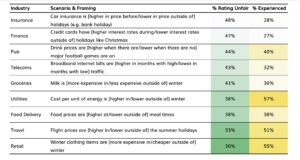
Source: Dectech Research July 2025, n = 1,166. % Experienced refers to the percentage of participants who reported having previously experienced surge pricing within that specific industry.
Who finds dynamic pricing most unfair?
Significant differences across consumers was also observed. Given the same price change scenario, men, younger consumers, those with higher income and those in London all perceived it to be fairer, likely in part due to lower price sensitivity in some of these groups
We then investigated the impact of how the price change was framed – e.g., flight prices are higher in the summer holidays vs. flight prices are lower outside of summer holidays (see Figure 1). Importantly, the respondent was experiencing a higher price in both framings, the price change was simply presented differently. Our results show a significantly higher perceived fairness when the focus was on the circumstances in which prices are lower. Even when consumers are experiencing higher prices, it is beneficial to frame the price difference as a discount at other times rather than a penalty at this time.
Figure 2: Effect of Consumer Characteristics and Framing on Fairness Perceptions
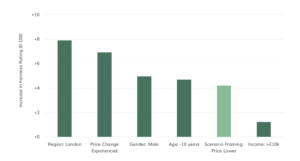
Source: Dectech Research July 2025, n = 1,166. Respondents are told that price is dynamic and they are charged a higher price than they might at other times. Scenario framing refers to presenting/explaining the dynamic pricing either as a higher price during high-demand periods or as a lower price outside those periods.
Does the communication of dynamic pricing matter?
Finally, we found that consumer reaction to price fluctuations is significantly affected by the explanation for these changes. Consumers were given a demand or supply-side explanation (see examples in Figure 3) and asked how acceptable the price change is. Price variations are more acceptable when caused by demand. The strongest examples of this are in Retail, Travel and Finance.
Figure 3: Acceptability Ratings of Dynamic Pricing by Reason Type
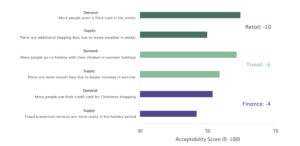
Source: Dectech Research July 2025, n = 1,166
Conclusions
These results show how brands could minimise any negative impact of necessary price changes.
The key insights are:
1. There are products that consumers assume will vary in price, and therefore retailers can maximise revenue by optimising those prices in a dynamic way. Unexpected fluctuations are significantly more damaging.
2. Where possible, the higher price should be framed as the base price from which you can discount, rather than framing the lower price as the base and increasing from there.
3. Brands are also in control of the explanation for the change, which can significantly impact how it is received by consumers. Explanations should focus on how consumer demand and behaviour lead to price increases, as consumers are now familiar with dynamic and surge pricing, and not focus on supply-side excuses that are the seen to be the brand’s responsibility to navigate.