Changing Attitudes Towards Driverless Cars
Posted: 29/09/2026

New technologies often trigger fear and uncertainty when introduced. Electric lighting was thought to negatively impact health1, the arrival of trains prompted fears about how travelling at that speed affects human bodies2, and television was criticised for its impact on family life3. As a technology becomes more visible, understood and integrated into everyday life, concerns become less prominent or change in nature. This provides useful context for understanding how attitudes towards driverless cars may be evolving.
Use of driverless technology is expanding in some countries, particularly in the US and China. Waymo launched its fully driverless ride-hailing service to the public in Phoenix in 2020 and has since expanded to other US cities, including San Francisco, Austin and Los Angeles, while companies such as Baidu and Pony.ai have expanded robotaxi services in China. However, at this point adoption among the wider public remains limited. A 2026 survey of Los Angeles County residents found that only 5% had used an autonomous ride-hailing service such as Waymo in the previous year4. In the UK, the technology is at an earlier stage, with automated vehicles being tested on public roads and the Government developing a framework for commercial self-driving passenger services. Uber launched the UK’s first robotaxi service in London in September 20265. New pilot schemes are expected to allow passengers to use fully self-driving taxi services from 2026, while the wider regulatory framework is expected to come into force from 2027.
As the technology continues to develop and expand, we see evidence of evolving attitudes in our own research. We reran research that was initially run in 2018, when expectations for self-driving vehicles were high, but they were not yet in use. At the time, there had been tests of fully driverless cars by companies such as Waymo, Uber, and Tesla, and the technology seemed to be moving rapidly. However, this bright outlook was soon dented by accidents. In 2018, an Uber self-driving car hit and killed a pedestrian in Tempe, Arizona, while a Tesla driver died after his autopilot car crashed into a concrete lane divider6.
Against this backdrop, our research shows that people are significantly less fearful towards driverless cars now than in 2018. When asked the main emotion they feel about being driven by one, the proportion selecting Scared fell significantly from 43% in 2018 to 34% in 2026, by far the biggest change we observed (see Figure 1). There have been small increases in the emotions Good and Amazed, and the proportion citing Nothing fell from 5% to 3%, suggesting slightly less apathy than eight years ago.
Figure 1: Emotions Showing the Largest Changes between 2018 and 2026
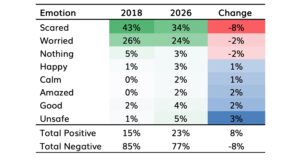
Source: Dectech Research, 2018 (N=1,068) vs. 2026 (N = 664). Question: What is the main emotion you feel about being driven somewhere by a driverless car?
However, this does not mean that concerns have disappeared. Scared and Worried remain by far the two most common emotions in 2026, indicating that safety concerns continue to shape perceptions of driverless cars. Interestingly, Unsafe increased from 1% in 2018 to 5% in 2026. One possible explanation is that greater exposure to driverless technology and more frequent coverage of real-world incidents may make specific safety concerns more salient, even as general fear declines.
Women are often reported to experience higher levels of anxiety than men7, a pattern also observed in attitudes towards technology – women are more sceptical about certain uses of AI8 and less likely to express positive attitudes towards the broader category of automated cars9. This is reflected in our study, with women showing higher levels of Scared and Worried than men in both 2018 and 2026. Women are just as negative towards driverless cars as they were in 2018, with the overall increase in positivity coming only from men. Women show decreased levels of Scared, but an equivalent increase in Worried indicates a change in how their concern is expressed rather than decreased concern.
Figure 2: Changes In Emotions by Gender
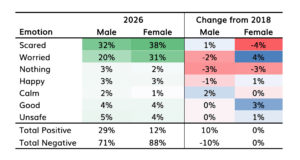
Source: Dectech Research, 2018 (N=1,068) vs. 2026 (N = 664). Question: What is the main emotion you feel about being driven somewhere by a driverless car? Change in scores is calculated as the 2026 score minus the 2018 score.
Age differences have also become more apparent. Figure 3 shows that, in 2026, under 40s are even more likely to report feeling engaged with driverless cars, alongside lower levels of Scared and Worried. In 2018, there were limited differences between age groups. All of the increased positive comes from younger age groups, indicating that familiarity and exposure to this emerging technology differ across generations.
Figure 3: Changes in Emotions by Age
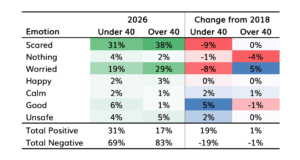
Source: Dectech Research, 2018 (N=1,068) vs. 2026 (N = 664). Question: What is the main emotion you feel about being driven somewhere by a driverless car? Change in scores is calculated as the 2026 score minus the 2018 score. Amazed is not included in this graph.
We also asked more specific questions to explore whether attitudes towards driverless cars change in different situations (see Figure 4). Respondents were asked their main emotion about being driven home from the pub or travelling on a motorway. We observed a slightly more negative reaction, and higher frequency of Scared, when the journey was on a motorway, likely due to higher speeds increasing safety concerns. However, when being driven home from a pub the reaction is significantly more positive, potentially as driverless cars are deemed safer than driving after consuming alcohol. Across both scenarios, women and those aged 40+ were consistently less positive.
Figure 4: Emotions by Scenario (2026)
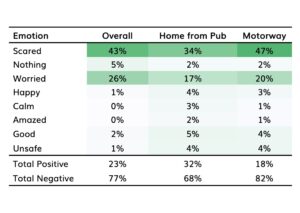
Source: Dectech Research, 2026 (N = 664). Questions: “What is the main emotion you feel about being driven somewhere by a driverless car?”, “What is the main emotion you feel about being driven home from the pub by a driverless car?” and “What is the main emotion you feel about being driven on a motorway by a driverless car?”
Our findings suggest people in the UK are beginning to feel more comfortable with driverless cars as the technology becomes more familiar, but there are still significant concerns around safety. The increased positivity is concentrated in certain demographics – i.e., men, younger age groups – so broader trust and subsequent usage will require effectively communicated and targeted reassurances around safety and the appropriate use cases for this technology.
1. Schivelbusch, W. (1988). Disenchanted night: The industrialization of light in the nineteenth century. University of California Press.
2. Schivelbusch, W. (1986). The Railway Journey: The Industrialization of Time and Space in the Nineteenth Century. University of California Press
3. Spigel, L. (1992). Make Room for TV: Television and the Family Ideal in Postwar America. University of Chicago Press.
4. Lindahl, C. (2026). Most Angelenos Still Wary Of Driverless Cars, USC Survey Finds. Los Angeles, CA Patch; Patch. https://patch.com/california/los-angeles/most-angelenos-still-wary-driverless-cars-usc-survey-finds
5. Kleinman, Z. (2026). What it’s like to ride in Uber’s new self-driving taxis in London. https://www.bbc.com/news/articles/ce9e838jzpzo
6. Lee, T. B. (2018). The hype around driverless cars came crashing down in 2018. Ars Technica; Ars Technica. https://arstechnica.com/cars/2018/12/uber-tesla-and-waymo-all-struggled-with-self-driving-in-2018/
7. Craske, M. G. (2003). Origins of phobias and anxiety disorders : why more women than men? Elsevier.
8. Gelles-Watnick, R. (2022). U.S. women more concerned than men about some AI developments, especially driverless cars. Pew Research Center. https://www.pewresearch.org/short-reads/2022/08/03/u-s-women-more-concerned-than-men-about-some-ai-developments-especially-driverless-cars/
9. DIAMOND project. (2021). Men and women experience different feelings while driving automated vehicles. Diamond-Project.Eu. https://diamond-project.eu/men-and-women-experiment-different-feelings-while-driving-automated-vehicles/