Drip Pricing: How Does Pricing Structure Impact Purchase Intent?
Posted: 24/04/2026

Drip pricing – decomposing a price into multiple components that are presented sequentially to buyers – is used extensively in certain industries. Airlines, for example, often start with a base flight price before adding a range of extras, some optional and some required, that eventually build to a significantly higher basket.
Experimental Design:
Our experiment measured the impact of drip pricing using two different groups of respondents, assigned at random. Group 1, whose journey is shown in Figure 1, replicates the structure of a drip pricing journey. Initially they see a base price (£82.80 in the Figure 1 example) and then an additional 10% charge is added to the basket before payment, yielding a total of £92.00. Group 2 replicates an equivalent online journey with only one question, as the total price of £92.00 is seen upfront as the product price.
The products seen by each respondent were chosen at random from a list of nine, each from a different industry, and the total price for each product was based on real-world prices. The additional charge was always 10% of the total price. By comparing the ratings and groups, we can measure how purchase intent has been impacted by the addition of a charge in a drip pricing structure.
Figure 1: Questions Seen by Group 1 Participants
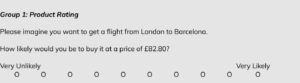
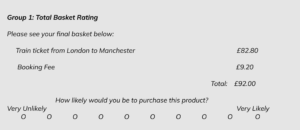
Source: Dectech Research July 2025 (N = 1,059 nat. rep.). Respondents were randomly assigned to two groups: Group 1 saw the base price followed by additional charges, while Group 2 saw only the total price with no breakdown.
What Do the Results Tell Us?
Our analysis found that drip pricing significantly decreases purchasing intent. Purchase likelihood decreased by -7.5 points (on a 0-100 rating) between Group 1’s initial product rating and their total basket rating (see Figure 2). Then, Group 2’s product rating allows us to deconstruct this 7.5-point fall into the impact of the increased cost versus drip pricing irritation. Purchase likelihood decreases by -2.9 points between the product ratings of Group 1 and 2, showing the impact of the increase in price. Hence the majority of the Group 1 drop, -4.6 points, is attributable to the drip pricing ambush.
Figure 2: Impact of Drip Pricing
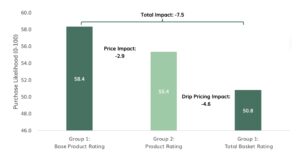
Source: Dectech Research July 2025 (N = 1,059 nat. rep.). Participants were split into two groups: Group 1 experienced drip pricing, seeing additional charges only at checkout, while Group 2 saw the full total price upfront. The drip price was always 10% and the final cost was always the same between groups.
The negative impact of drip pricing was seen across most industries, but the scale of the impact varied substantially. It’s most damaging in Retail, Grocery and Travel (see Figure 3). These industries have the highest initial purchase intent, so the frustration of additional charges may be higher when consumers are more engaged with the purchase journey and have a higher base purchase intent to decrease from.
Figure 3: Drip Pricing Damage across Industries
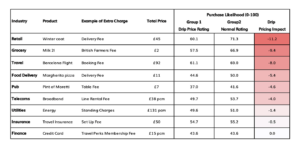
Source: Dectech Research July 2025 (N = 1,059 nat. rep.). The table presents purchase likelihood for Group 1 and Group 2, along with the score differences between the two groups across industries included in the survey.
Conclusions
This research highlights the significant impact of how prices are structured and communicated. Our analysis shows the dangers of drip pricing, which interrupts the purchase journey and frustrates consumers. Retailers implement this pricing structure as it allows them to advertise a lower base price to consumers, in their own comms and in competitive environments like price comparison websites. For some brands and industries, the resulting higher volume of consumers starting the purchase journey will be worth the risk of high drop-out and negative perceptions of the brand. For others, the risk will not be worth it.
In more complex journeys, a consumer may be invested enough that they’re not willing to drop out of that specific purchase, but their brand loyalty is harmed significantly. This brand harm may be weaker in industries with low purchase frequency, as consumers have forgotten the frustration when they come to purchase again, but the harm is greatest in industries with high frequency purchases and less differentiated, easily substitutable brands. The risk will also be lower in cases where the extras are optional, rather than compulsory additions like a delivery fee. The website design will also impact how frustrating the experience is. Overall, each brand must consider their own position in the market and ensure that expected gains outweigh the clear risk before implementing a drip pricing structure.