Expected Price: How Should Consumer Expectations Shape Pricing Strategies?
Posted: 25/08/2026
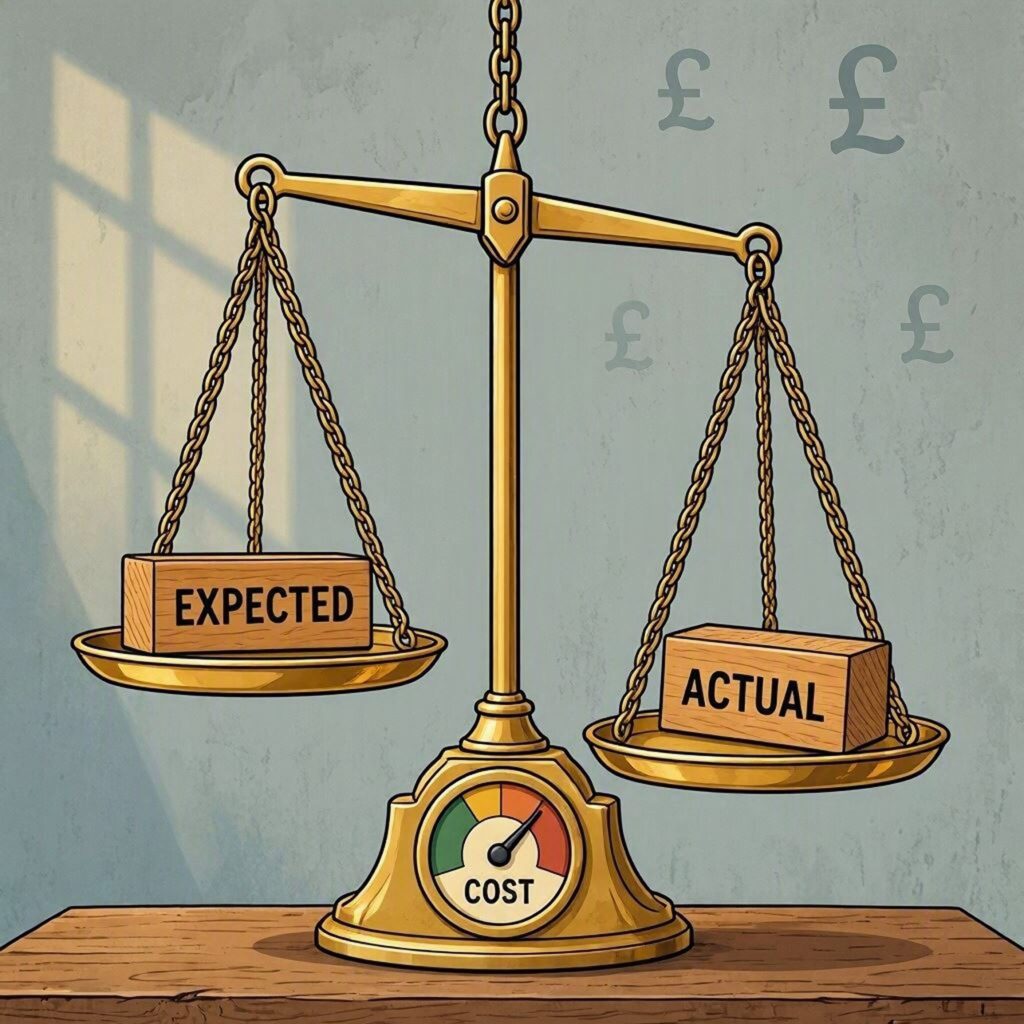

Price elasticity measures demand sensitivity to price, but demand depends not only on absolute price but also on how far it is from consumer expectations. Expectations derive from historic pricing, competitor pricing, substitutes, the macroeconomic context and more. Prices far above or below expectations immediately affect purchase rate and margin and have a longer-term brand impact. Retailers must optimise margin distribution by removing damagingly high prices while maintaining a few low ‘hero’ prices.
We studied the accuracy and spread of price estimates without reference prices. Respondents estimated the price – in pounds and pence – of a branded product from one of eight industries (see Figure 1) based on a detailed description (e.g., “a Hovis seed sensations loaf of bread (800g) from Waitrose”) and rated how confident they were of their estimate.
Consumers provided reasonable estimates, with a tendency to overestimate. Travel, Utilities and Insurance are the most overestimated. They are all relatively infrequently purchased, both Utilities and Insurance use bespoke pricing, and Travel has high price volatility across times and routes, so consumers have fewer relevant reference points in those industries. Retail is the only industry that was on average underestimated, due to underestimations of how expensive Gucci is. Across industries, consumers who recently purchased the product or are familiar with the brand show significantly lower estimates, closer to real-world prices.
Figure 1: Estimated Price vs. Real Price by Industry
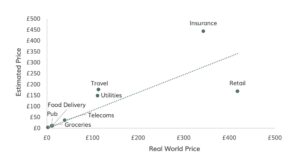
Source: Dectech Research July 2025 (N = 1,059 nat. rep.). Respondents were asked to estimate their expected price to pay for three products across three brands, within up to three industries. The graphic shows the relationship between the average expected price in each industry and the average of the corresponding real-world prices.
Brands can command substantially different price expectations, the degree of differentiation varying by industry. Travel and Retail show a clear premium brand for which price estimates are significantly higher than both other brands (Figure 2). British Airways is a +45% premium beyond Ryanair, driven by consistent brand positioning by both. Consumers know that Gucci is a luxury brand and estimate H&M to be a 10% discount from M&S. Pubs show a value brand, as consumers expect prices to be at least 14% lower in Wetherspoons. In Groceries, Asda estimates are significantly lower than Waitrose, with Sainsbury’s in between. Other industries show less variation.
Figure 2: Estimated Product Price by Brand
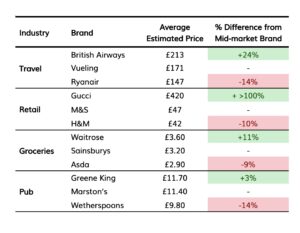
Source: Dectech Research July 2025 (N = 1,059 nat. rep.). Respondents were asked to estimate their expected price to pay for three products across three brands, within up to three industries. The table shows the average expected price by brand and industry.
Consumers show relatively consistent confidence in their estimates across brands in the same industry, with higher variation between industries (Figure 3). Confidence reflects the ease with which consumers can retrieve consistent memory cues, so frequent engagement with an industry like Grocery increases the volume of memory cues. Conversely, confidence is lower for prices that are unstable across time and brands, which will affect Travel, where knowing the price of one flight is not necessarily informative when estimating the price of a different route, airline, airport, date or time of day.
Figure 3: Stated Confidence of Estimated Product Price by Industry
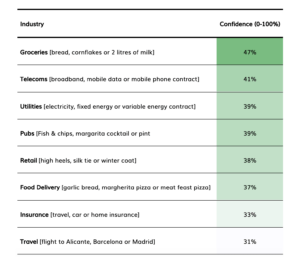
Source: Dectech Research July 2025 (N = 1,059 nat. rep.). Respondents were asked to indicate their confidence in their price estimates for each product on a 0% to 100% scale in 10% increments. The table shows the average confidence by industry. The products shown in each industry are in brackets.
Our results highlight the importance of understanding the brand-specific expectations consumers bring to purchase decisions. Brands must know where consumers expect each product to sit within their range and the market to truly optimise revenue and margin. This insight can shape higher-level strategies on pricing architecture, limit price shocks, and identify prices to feature in above-the-line marketing. The tendency for unfamiliar consumers to assume higher prices is crucial for acquisition strategies and new brand or product launches.